Commercial Water Damage Restoration Near IAH Airport
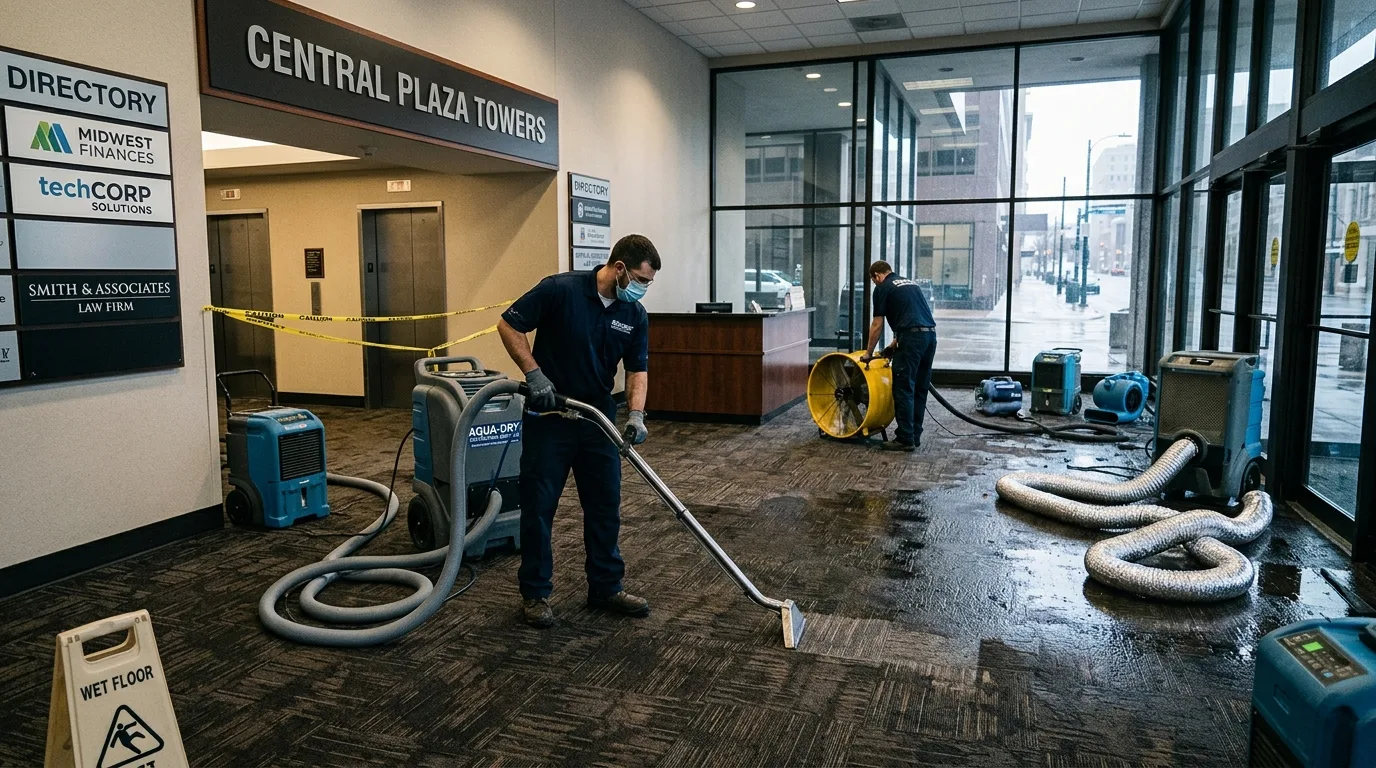
George Bush Intercontinental Airport anchors a commercial corridor that extends through north Houston and into Humble — hotel properties, distribution warehouses, business parks, and light manufacturing facilities that serve the IAH travel and logistics ecosystem. Commercial water damage restoration in this corridor presents requirements that differ fundamentally from residential restoration: business continuity is measured in daily revenue lost, tenant lease obligations create timeline pressures absent from homeowner scenarios, and the combination of complex HVAC systems and sensitive equipment means that water intrusion scope must be assessed at a level of precision residential work rarely demands. This guide covers what commercial operators near Humble and IAH need to know about water damage response. See also our guide on choosing a qualified water damage restoration company in Humble for the credential verification steps that apply equally to commercial engagements.
Commercial Water Damage Near IAH — We Respond 24/7
Business continuity-focused water mitigation for Harris County commercial properties. Call (877) 698-1311.
Why Commercial Water Damage Is Different From Residential Restoration
The physical science of water damage is the same in commercial and residential settings — Category classification, IICRC drying standards, psychrometric drying principles all apply identically. What differs is the operational context that surrounds the restoration work.
A hotel near IAH with flooded lower-level guest rooms loses room revenue for every night those rooms are unavailable, faces potential reputation damage from guest displacement, and has contractual obligations to guests already checked in. A distribution warehouse that experiences a sprinkler system discharge or roof leak during Harris County flooding events has inventory at risk, shipping commitments, and commercial lease terms that specify maintenance and habitation standards. A business park office suite has tenant relationships and lease obligations that create legal exposure alongside physical damage.
Water mitigation in commercial settings must therefore be planned around business continuity, not just around the physical drying timeline. This means phased work plans that restore portions of the affected space to operational condition before the full drying cycle is complete — using containment barriers, redirect HVAC, and targeted extraction to minimize the operational footprint of the restoration work.
Roof Leaks and Rooftop HVAC: The Most Common Commercial Water Entry Points
For commercial properties in the Humble and IAH corridor, the most common water damage sources are distinct from the residential profile:
Flat roof penetrations and membrane failures: Commercial buildings in the Houston area predominantly use flat or low-slope roof systems — EPDM membrane, TPO, or modified bitumen. These systems are designed for the heavy rainfall common in Harris County, but age-related membrane cracking, penetration seal failures around rooftop equipment, and storm damage create water entry points that can flood ceiling plenum spaces and penetrate into occupied floors below. During major storm events, ponding water on flat roofs can overwhelm drainage capacity and create hydrostatic pressure that forces water through minor penetrations.
Rooftop HVAC condensate overflow: Commercial HVAC condensate drain lines — when blocked by debris or biological growth — overflow into ceiling spaces and gradually saturate insulation, ceiling tiles, and structural components above occupied areas. These events often begin slowly and are discovered only when ceiling tiles sag or visible water staining appears. Structural drying of the ceiling plenum is required before new ceiling materials can be installed, and HVAC inspection for biological growth in the condensate system should accompany any restoration.
Sprinkler system discharge: Fire suppression system activations — whether from actual fire or from system malfunctions — release significant water volumes quickly in commercial settings. A single sprinkler head activation can release 15–25 gallons per minute; multi-head activations in a large commercial space can release thousands of gallons before suppression. The immediate response priority is the same as any water emergency: water extraction of standing water and documentation before any cleanup begins.
Plumbing failures in restrooms and break rooms: Commercial plumbing serves high-frequency use and fails accordingly. Supply line failures, toilet flange cracks, and drain line blockages create Category 2 and Category 3 water events in commercial restrooms that require biohazard decontamination protocols.
Commercial Restoration Near Humble and IAH — Full-Service Response
Structural drying, equipment protection, and insurance documentation. Call (877) 698-1311.
Protecting Sensitive Equipment During Commercial Water Damage
Commercial facilities near IAH often house equipment that represents greater financial exposure than the building itself: server infrastructure, medical equipment, manufacturing machinery, commercial kitchen equipment, and specialized logistics technology. The priority sequence in commercial water damage response must account for equipment protection alongside structural concerns.
When water enters a commercial space, electronics and electrical equipment in the affected zone should be powered down immediately — not to save the equipment from direct water contact (if water has reached equipment, it is already a loss), but to prevent electrical hazards and secondary damage from power surges during restoration. After power-down, document all affected equipment with photographs before any movement or drying attempts.
Controlled dehumidification of the affected space must begin before any equipment is restored to operation. In Humble’s humid subtropical climate, residual ambient humidity alone — without any remaining standing water — can cause progressive corrosion in server components, electrical panels, and precision equipment if restoration teams leave the dehumidification phase incomplete. Commercial restoration requires verifying dry standard in equipment-sensitive areas before equipment teams return for assessment.
Commercial Insurance Claims: What Differs From Residential
Commercial property insurance for Harris County businesses typically includes both property coverage and business interruption coverage — two separate claim streams that require different documentation.
Property damage documentation for commercial claims follows similar principles to residential: moisture logs, psychrometric readings, photo documentation at each restoration phase, and a complete scope-of-work document specifying what was damaged and what restoration work is required. Commercial adjusters generally require more detailed documentation than residential adjusters because commercial claim values are higher and subject to more scrutiny.
Business interruption documentation requires establishing the revenue impact of the downtime — which means connecting the physical damage timeline to operational records showing revenue generation during equivalent prior periods. Your restoration team can document the restoration timeline; your accountant or CFO documents the revenue impact. The combination supports the business interruption claim.
For commercial tenants (rather than property owners), lease review is essential before beginning restoration: some commercial leases specify which party is responsible for water damage restoration and what notification obligations exist. See the insurance guide for water damage claims in Harris County for general claims documentation context.
Frequently Asked Questions
How quickly can commercial water damage restoration begin near IAH in Humble?
We provide 24/7 emergency response with equipment-ready crews across all of Harris County, including the IAH airport corridor and Humble commercial districts. Response time for commercial emergencies averages 90 minutes or less during standard conditions. During major Harris County flood events when multiple calls come in simultaneously, we prioritize by severity and actively communicate ETAs. Call (877) 698-1311 immediately — do not wait for business hours.
Can commercial water damage restoration be done in phases to minimize business disruption?
Yes — phased restoration is standard practice for commercial facilities where operational continuity is required. We work with facility managers and business owners to sequence extraction, drying, and reconstruction to minimize operational downtime. This may mean completing extraction and initial flood damage cleanup in the highest-priority areas first, establishing containment barriers to allow continued operation in unaffected areas, and scheduling reconstruction work during off-hours or weekends. The phasing plan is established during the initial assessment and documented for insurance purposes.
Do commercial water damage repairs in Humble require permits?
Yes — commercial repair work that involves plumbing, electrical, or structural components requires permits from the City of Humble Building Department, and larger projects require licensed contractor registration in the City of Humble. Commercial construction also typically requires a licensed contractor of record. See the Humble building permits guide for permit requirements, and see the complete water damage restoration guide for the full restoration context applicable to both residential and commercial properties.
Commercial Water Damage — IAH Corridor and Humble, TX
Call Humble Water Damage Restoration at (877) 698-1311 for immediate commercial response.
Related reading: